Short courses. Real tasks. Clearer choices.
Course Tasters
Would I genuinely enjoy this career?
Pick a role. Step inside. See how you think — a short taste of the job, not a compressed degree.
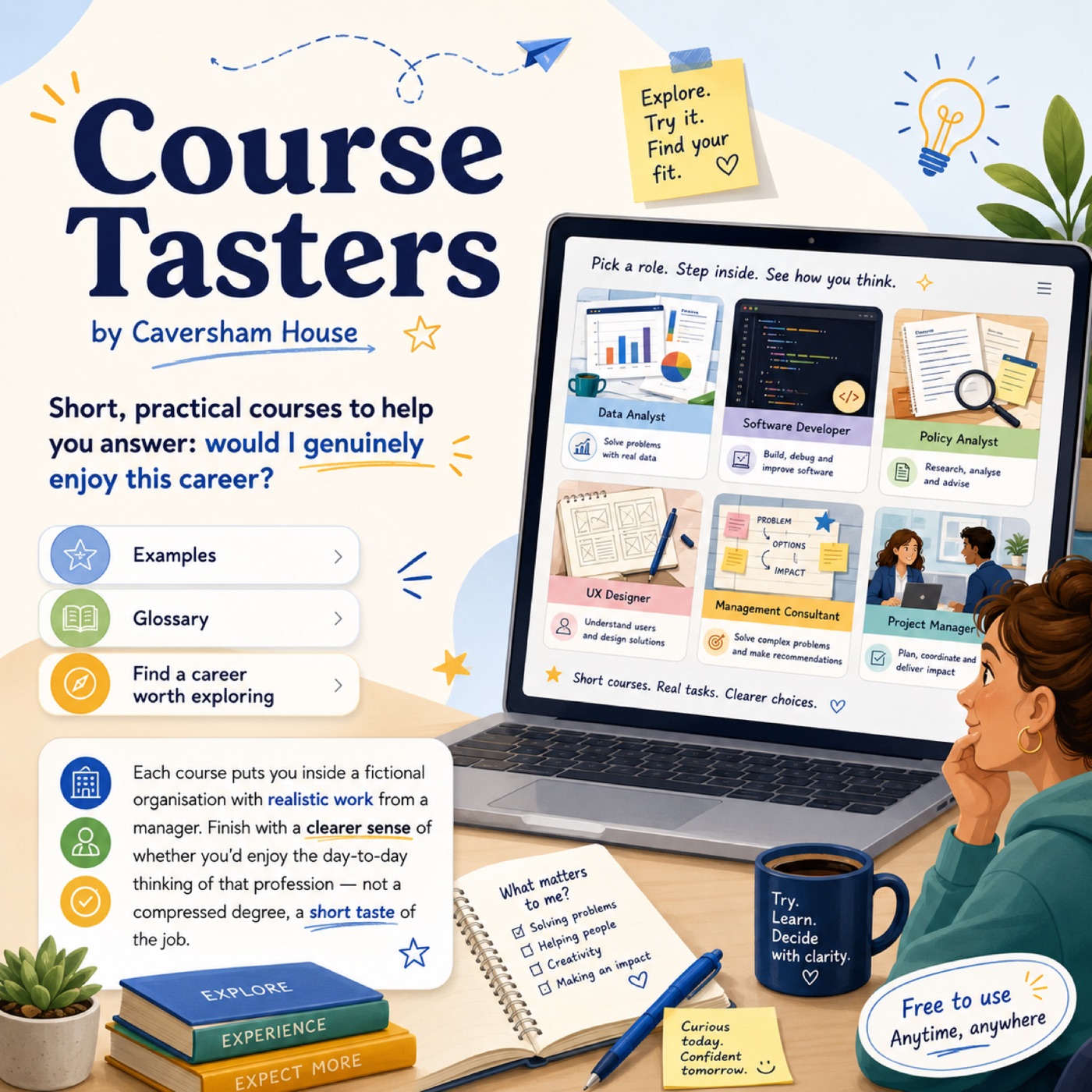
- Realistic work from a fictional manager
- Finish with a clearer sense of day-to-day fit
- Free to use — anytime, anywhere
Data Science
Data scientists turn messy real-world numbers into answers someone can act on. You find reliable sources, clean the data, explore patterns with code, then brief a manager on what it shows — and what it does not.
Jobs this leads toward
- Data scientist
- Analytics consultant
- Business intelligence analyst
- Research analyst
Skills you'll practise
- Finding and cleaning datasets
- Python, pandas and charts
- SQL queries
- Clear written briefings
Quantitative Finance
Quants treat markets as data. They measure risk, test trading ideas, compare portfolios under uncertainty, and write research that helps decide what to buy, hold or avoid.
Jobs this leads toward
- Quantitative analyst
- Portfolio analyst
- Risk analyst
- Investment research associate
Skills you'll practise
- Returns, volatility and correlation
- Strategy backtesting
- Monte Carlo thinking
- Investment research notes
Actuarial Science
Actuaries put a price on uncertainty. They model how often costly events happen, set fair premiums, estimate pension costs as people live longer, and advise boards on capital and risk.
Jobs this leads toward
- Actuary
- Pricing analyst
- Pensions analyst
- Risk consultant
Skills you'll practise
- Frequency and severity modelling
- Pricing and fairness judgement
- Reserving and capital thinking
- Committee-ready recommendations
Machine Learning
Machine learning engineers turn tables of measurements into models that predict. They build features, train and evaluate classifiers, watch for overfitting, and report what a model is good enough to decide — and when it is not.
Jobs this leads toward
- Machine learning engineer
- Applied ML scientist
- ML ops / model analyst
- AI product analyst
Skills you'll practise
- Features and labels
- Training and evaluating models
- Generalisation checks
- Model reports for stakeholders
Computer Vision (Analyst)
Mapping analysts use computer-vision land-cover maps without building the models themselves. You inspect outputs, spot where a map looks unreliable, and write briefs rangers and ecologists can act on.
Jobs this leads toward
- Mapping / GIS analyst
- Conservation data analyst
- Remote sensing analyst
- Environmental briefing officer
Skills you'll practise
- Reading habitat maps critically
- Interpreting model confidence
- Explaining limits to non-coders
- Actionable field briefs
Computer Vision (Developer)
Computer vision developers teach machines to interpret images. You turn pixels into arrays, build filters and CNNs in Python, train classifiers on aerial tiles, and evaluate where the model succeeds or fails.
Jobs this leads toward
- Computer vision engineer
- Deep learning engineer
- ML engineer (vision)
- Applied AI developer
Skills you'll practise
- Images as numerical data
- Filters, CNNs and transfer learning
- Training and evaluation in Python
- Model files and confusion matrices
Want another career?
Missing a profession you'd like to try? Message Chris Hornby on LinkedIn and say which career you'd like to see next.